Our Heritage
Unchanged Since 1913.
Woodlands is the only Sandbelt original that has never moved. While other clubs relocated or rebuilt, Woodlands has remained on the same sandy ground where it all began. This permanence has allowed us to preserve a style of golf that is disappearing elsewhere, and it has created a sense of place that simply cannot be replicated.
From humble beginnings on the Mayfield Estate to hosting Victorian Opens and nurturing future champions, our story is one of quiet persistence. We’ve never chased the spotlight. We’ve never needed to. The golf has always spoken for itself. To rise from “golfing in the paddocks” to hosting the State Championship in just twenty-one years was a magnificent achievement. Today, Woodlands is one of Australia’s leading golf courses. And, quite possibly, the most under-rated.
The Origin Story
“Golfing around Mordialloc at the time was mainly confined to knocking a ball around the paddocks.”
When Western District schoolteacher George Rogers was transferred to Chelsea in 1912, little could anyone foresee the impact on Melbourne golf. Welcomed to the Chelsea State School by Headmaster Millar, Rogers beckoned to learn more about “Mayfield” – the 314-acre property he’d quickly become fixated upon. Millar obliged and arranged an introduction to a gentleman called Whitfield, who was managing the Mayfield Estate.
Rogers and Whitfield met over afternoon tea and, at one point during their meeting, the legal owner of Mayfield – “The Count” – made his grand entrance. Sparing the ensuing cut-and-thrust details, permission was granted to play over Mayfield. The next step was the formation of a golf club.
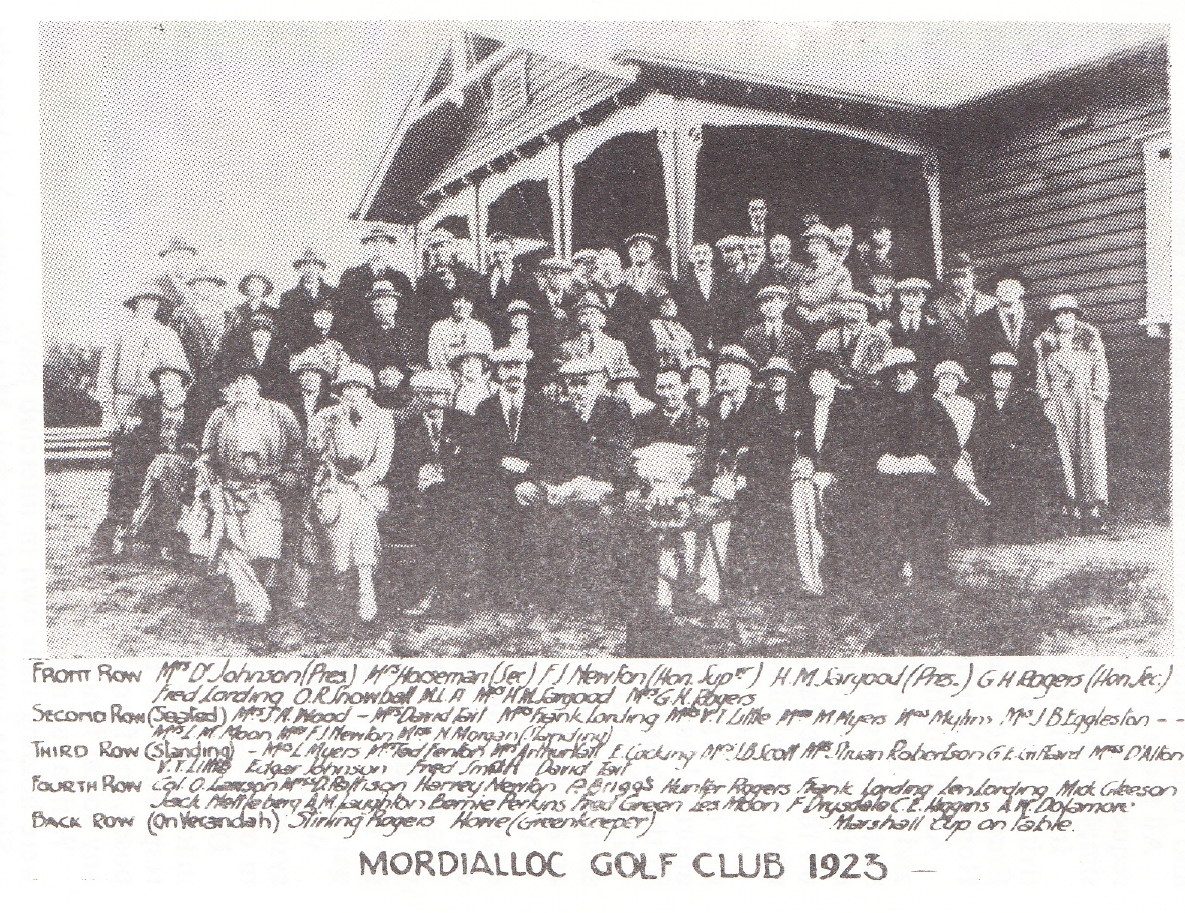
A motion was passed on 17 July 1913, formalising the club name of Mordialloc Golf Club and limiting its membership to fifty. An early Melbourne professional, Richard Banks, had made a study of golf courses and was contacted to lay out nine holes in readiness for Opening Day on 6 September 1913.
Mayfield’s parkland environment included heavily treed sections; fairways comprised various natural grass species and were sufficiently uneven to require constant rolling. Cattle and sheep grazed over Mayfield, wreaking havoc on fairways and greens. Caddies spent much of their time diverting sheep away from the manure-scented putting surfaces, fighting a losing battle that eventually forced the club to erect protective wire fences. Traditional sand bunkers were initially prohibited by the land trustees, so wire-netting hurdles were erected and positioned across the fairways instead.
It was golf at its most improvised. And from those unlikely beginnings, something extraordinary grew.
The Mayfield Estate
Our story begins with the land itself. The light, sandy soil of the Mayfield Estate, perfect for drainage, ideal for golf, was first purchased by Jonathan Parker in 1855 for just £629. The property would pass through several colourful hands, including Count de Castelnau, whose son Edouard (the “Mad Count”) became a local legend. It was this land, with its natural contours and sandy foundation, that would provide the perfect canvas for Sandbelt golf.
The Price of Sandbelt Land
Land prices varied wildly across the Melbourne Sandbelt: Kingston Heath paid just over £37 per acre; Victoria Golf Club at Cheltenham parted with £120 per acre; Yarra Yarra’s East Bentleigh site cost £150 per acre; while Royal Melbourne paid £400 per acre for its Black Rock property. Woodlands’ purchase of Mayfield in 1933 at roughly £70 per acre was, by comparison, a sound deal.
The Foundation Years
1855
The Land
Jonathan Parker purchases the Mayfield Estate for just £629. The light, sandy soil, perfect drainage, ideal for golf, would one day provide the foundation for a great Sandbelt course. But that was still half a century away.
1874
The Count
Count de Castelnau purchases the Mayfield Estate, beginning one of the more colourful chapters in local history. His stepson, Edouard, dubbed the “Mad Count”, becomes a local legend. The property’s natural contours and sandy soil quietly await their true calling.
1913
The Foundation
Mordialloc Golf Club is formally established on 17 July, with subscriptions fixed at one guinea and membership limited to fifty. Richard Banks lays out nine holes on natural grass. Opening Day, 6 September 1913, marks the beginning of what will become one of the Sandbelt’s most enduring institutions.
1919
Eighteen Holes
Club professional Sam Bennetts lays out a new nine within a month, expanding the course to 18 holes across 158 acres. English golf architect J.D.A. Scott provides guidance on course bunkering and the potential for additional holes, laying the architectural foundations that still define the layout today.
1921
The Pioneer Survey
The club enlists bunker expert Mr Plant, whose recommendations are based on an aerial survey by Hunter Rogers, the first in Australian golfing circles to successfully undertake such a survey. His groundbreaking action of isolating and recording topographical features from the air would inform the strategic bunkering that defines the course. Hundreds of native trees are planted.
1925
A New Identity
When the club becomes a company, members vote on a name change. “Braeburn” gathers considerable support, but “Woodlands” wins, a fitting tribute to the parkland setting that had captivated George Rogers from day one. Architect J.D.A. Scott implemented several changes to the course, making it largely what golfers see now. An identity is born.
1927
From Ashes
A devastating fire guts the clubhouse. In a stroke of serendipity, the estimated damage bill matches the budgeted upgrade figure almost exactly, prompting the commission of the current “American Prairie” style clubhouse by architect Edward Billson. What could have been a setback becomes a turning point.
1928
The Swifts Creek Connection
In a legendary move, the club purchases a liquor licence from a tiny, dying club in the Omeo district, ensuring members could enjoy a well-earned drink at the 19th hole. The resourcefulness that defined the club’s early years was alive and well.
1933
Securing Mayfield
The club purchases the Mayfield Estate from the Fonseca Estate for £11,000 — roughly £70 per acre. In 1929, the fairways had been ploughed up and sown with couch grass. Now, under Mick Morcom’s counsel, the course is seeded with Chewing Fescue and New Zealand Brown Top. Flowering gums and wattles are planted. The canvas is becoming a masterpiece.
The Championship Years
1934
Championship Status
Woodlands is awarded the Victorian Amateur Championship — rising from “golfing in the paddocks” to hosting the state championship in just twenty-one years. Legendary architect Alec Russell, partner to Alister MacKenzie, begins reshaping the course, designing the 11th, 16th, and 17th holes over the following two years. His strategic sophistication endures to this day.
1948
Thomson’s Triumph
A young Peter Thomson defeats Doug Bachli at Woodlands to win the Victorian Amateur — a victory that foreshadows one of the greatest careers in Australian golf. Thomson would go on to win five Open Championships, but this was where it began to take shape.
1991
Allenby’s Record
Amateur Robert Allenby shoots a course-record 66 to win the Victorian Open at Woodlands — a performance that announced the arrival of one of Australia’s most talented golfers. The course, now over seventy years old, proves it can still test the best.
2010
Modern Revival
A major clubhouse modernisation brings Woodlands into the twenty-first century — without sacrificing the character that makes it special. The original charm and atmosphere are retained, while significant renovations ensure the facilities match the quality of the course. A balance few clubs manage to strike.
2013
The Centenary
One hundred years after George Rogers knocked a ball across the Mayfield paddocks, Woodlands celebrates its Centenary. Tom Doak, one of the game’s most celebrated architects, designs the 19th hole to commemorate the milestone. It is a testament to the club’s commitment to world-class architectural standards well into its second century.
The Architects of Woodlands
Our course bears the fingerprints of some of the most influential figures in Australian golf course architecture.
J.D.A. Scott
English golf architect who came to Australia in the mid-1920s. His advice on course bunkering and the potential for new holes laid the architectural foundations that still define the layout.
Mick Morcom
The lauded greenkeeper at Royal Melbourne, Morcom was commissioned to report on conditions and provided counsel on greens preparation, seeding, and conditioning. His influence helped transform raw farmland into championship-calibre turf.
Alec Russell
Partner to the legendary Alister MacKenzie, Russell redesigned key sections of the course in the mid-1930s, designing the 11th, 16th, and 17th holes. His influence brought a layer of strategic sophistication that remains intact today.
Tom Doak
One of the modern game’s most celebrated architects, Doak designed our Centenary 19th hole in 2013 — and rated our 15th as one of the 18 best par 5s in the world. He regards Woodlands as one of the finest courses on the Sandbelt.
Champions of Woodlands
The course has nurtured remarkable talent. Two members, in particular, have achieved at the highest level.
Margaret Masters
Margaret Masters joined Woodlands as a junior and won the first of nine Women’s Club Championships at age nineteen. She annexed five Victorian Amateur Championships, along with the Australian, New Zealand, South African, and Canadian Championships.
Masters proudly represented several Australian international touring teams before becoming the first Australian woman to turn professional and compete in America, where she enjoyed considerable success on the LPGA Tour — with two victories and five runner-up finishes. Margie was a member of the LPGA America (tournament division) and Victorian Golf Hall of Famer.
Stephen Allan
Coined “The Baby Face Assassin” by the press, Stephen Allan won the 2002 Australian Open at Victoria Golf Club. Diminutive in stature but immense in ability, Allan turned professional in 1996, qualified for the European Tour the following year, and won the German Open in 1998.
One stellar performance was heading the 2000 USPGA Tour School — perhaps golf’s greatest endurance test. Based in Arizona, Allan has been a regular member of the US Tour. He proudly represented Woodlands in local pennant, was a Victorian State Team representative, and was twice Club Champion (1991 and 1994).
More recently, Woodlands has produced Nathan Holman (2015 Australian PGA Champion), Brad Lamb (2000 Victorian Open Champion), and Julienne Soo (Symetra Tour). The club’s Division One pennant teams savoured victory in 1995, 1996, 1998, and 1999.
The Heritage Group
The club has established a Heritage Group dedicated to collecting and collating all historic items pertaining to the club’s history — a body of work spanning over 25 years. If you have, or know anyone who may have, historic items of interest, the club would greatly appreciate hearing from you.